Schultz Help, LLC
taking good ideas and making them great  |
 |
 |
Electrical Engineering and Design Services
Although most projects are under non-disclosure, here's an example of
a simple circuit that is a Schultz Help original design that generates the Crank Angle Sensor
(CAS) signal
for a performance car computer.
This circuit allows benchtop testing of the car's ECU as if it actually has a
running engine attached. First we verified the actual CAS signal of the running vehicle...
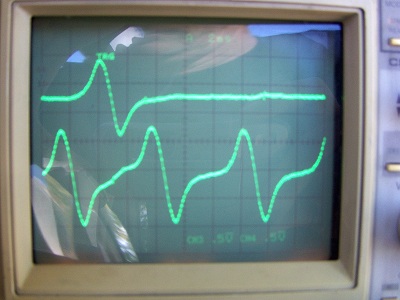
This is a magnetic type pickup with a falling edge trigger that has
12 cam pulses for every one crank pulse. The signal centers on
ground, and has a peak to peak voltage of around 24 volts.
An arbitrary waveform generator could handle this, but that would be too expensive
to add into a product. So for this project we used an inexpensive mixed signal microcontroller.
We coded the controller to generate a separate "high" and "low" pulse for each signal. This allowed
control of both the pulse duration and total frequency while forcing the 12:1 pulse
ratio to
remain constant.
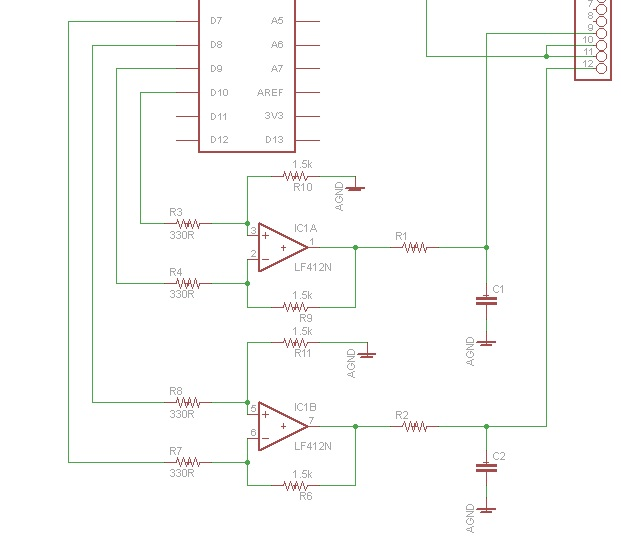
The microcontroller and code created four separate 0 to 5 volt control pulses that will be fed into two difference amplifiers with +/-12 volt rails and output filters. This will amplify the signal to the correct voltage and give nice sharp falling edges for the ECU to trigger on. Part of the difference amplification schematic is shown here...
A prototype was created and attached to the ECU with excellent results.
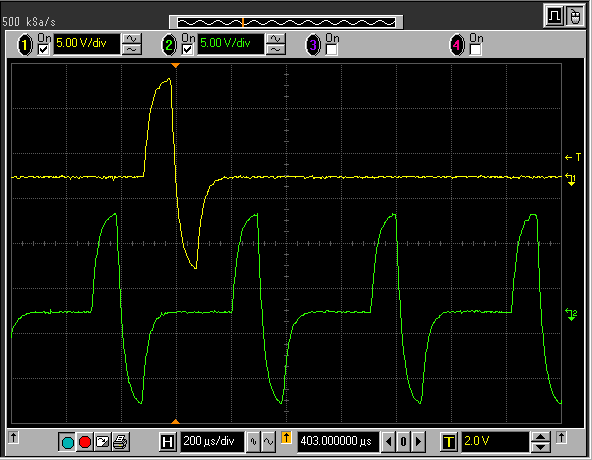
The generated waveform has even cleaner falling edges
than the original, which allows for very accurate measurements of ignition
and fuel injection timing. Since its creation, this circuit has been
extensively tested and has proven to be robust,
repeatable, and reliable. The generated signal waveform is shown here...
As with all Schultz Help designs,
we deliver high performing and cost effective
results in tight time schedules.
If you're ready to take your project to the next level, then please
click "Contact" above and we will work diligently to make you a satisfied
customer.